
Update: The game has now been published under the CC-BY license for you to enjoy without legal worries. If you would like to support me in publishing open access teaching materials like this, feel free to buy me a chocolate bar: MobilePay
It’s fun to design educational material with creative constraints.
So when asking myself how can I explain – to people with ZERO programming background – how a neural network works? I decided to give myself the constraints that it must be done entirely intuitively and without explaining it to them. Further, it should use no or very limited digital aids (so no showing how one actually works and messing around with training data and parameters!).

I’ve made a human-like board game to explain statements and sequences using only images (the MyBot game – available here) based off the RoboRally board game which basically does exactly that, I deciced I wanted to try and develop a game around the central concepts of input layer, output layer, neurons and weights. Perhaps heavily inspired by one of my favorite board games SET, I decided to create a card game for this.
The game has to be played by 5 people. One person is the “neural network” and has to classify (output layer) an object (in this case, a fruit) using only information from their input layer. The input layer (the other 4 players) get a card which visually encodes part of the input layer (the fruit). The input layer (the four card-receiving players) must then explain their “input unit” to the player pretending to be a neural network. Based on the information the guesssing player receives (propagation through the neural net), the guessing player must classify the object. In the process of doing so, he or she may “put weight” on different aspects/features, simulating how an activation function work. At least, that’s the point, I’m trying to illustrate – but of course it’s quite simplified to work in the shape of a cardgame.
Below is an example of a set of four cards used to exemplify a fruit.
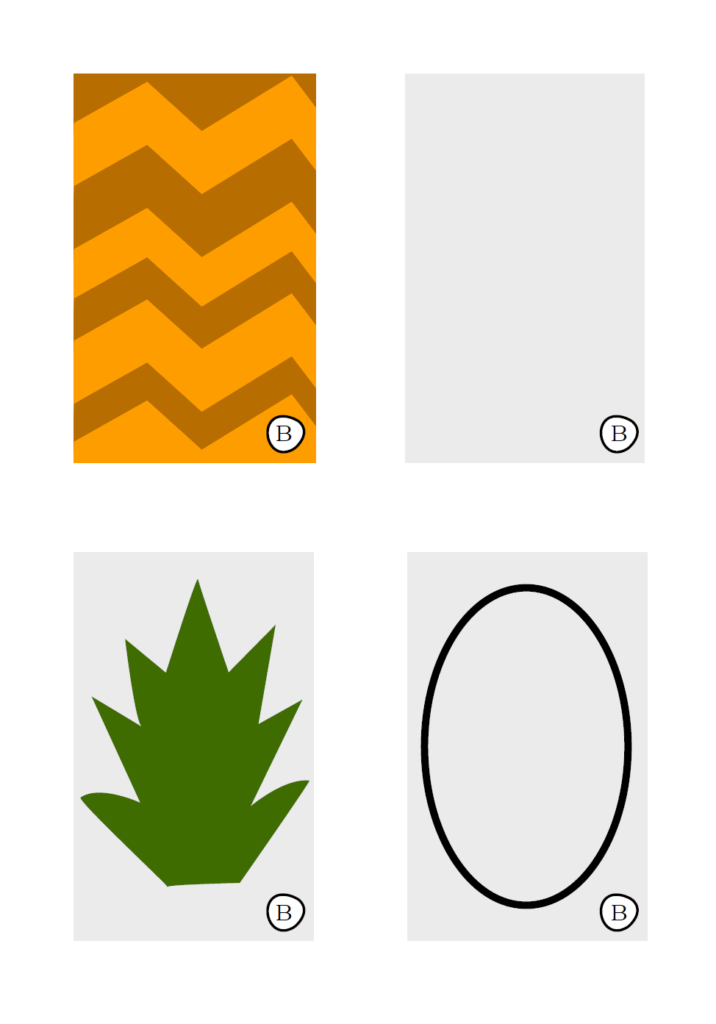
As you might have already noticed, the cards together show the “features or attributes of a pineapple” (color, shape, stem, seeds) in the same way that the SET game has different attributes. However, each player isn’t aware of what they are looking at, much in the same way that any one neuron in a neural network doesn’t necessarily have any real-life meaning. The guessing player might proceed to classify the entire input layer (all 4 cards) as a pineapple putting “weight” on the stem, signifying that one neuron “fires” and others do not. For other cards, it’s more of a combination of neurons that fire because multiple activation functions have been triggered.
Players can take turn being the “guesser” and the input layer. After playing the game, you can ask the players how they decided what to classify each object as? When did they become certain (enough)? Did they classify all of them correctly?
After playing the game, I would give a – very simplified – presentation of how the concepts that the players now (hopefully) intuitively understand relate to the mathematical model (CNNs).
After the game, you can also have students play around with Googles Teachable Machine to see how it fairs in classifying candy (licorice vs winegums) and talk to them about what happens if the training data doesn’t contain any licorice eggs.
To play the game, you need my deck of cards which you can print from the file listed below. Make sure to print in duplex on paper as thick as your printer will allow for duplex printing. There is also an instructionset available upon request.
If you are my colleague at VIA, feel free to reach out if you want an introduction beyond what is provided here – I should be pretty easy to find in Outlook. If you are not at VIA and would like me to come present the game to your your institution (faculty or teachers), please do send me an email. My e-mail is the same as my domain-handle and then you just add at gmail.com 🙂
Files can now be downloaded on the Zenodo repository:
https://doi.org/10.5281/zenodo.17960399
Cite my work? You can cite all versions by using the DOI 10.5281/zenodo.17960399. This DOI represents all versions, and will always resolve to the latest one.